Why AI Agents Need SPIFFE, and Why Riptides Is the Seamless Way to Deliver It
As AI agents grow in sophistication and autonomy, their need to securely communicate with third-party services and other agents becomes critical. These communications require strong authentication, fine-grained authorization, and end-to-end encryption—especially when AI agents are used in environments where trust boundaries must be enforced and regulatory controls apply.
At the heart of this challenge is the question: How do you securely authenticate and authorize software agents that have no human operator?
This post explores how the SPIFFE identity standard, when paired with a powerful identity management layer like Riptides, provides the missing security primitives for AI agents—without burdening developers with the complexity of identity management.
The Problem – AI Agents Need Secure Identity
Modern AI ecosystems are increasingly composed of multiple collaborating agents, often augmented with third-party plugins, tools, or services that provide computation, storage, or other critical functions. With the rise of Model Control Plane (MCP) systems, agents are beginning to delegate tasks to external software components in real-time.
These interactions, while powerful, introduce a deep trust problem:
- How does a third-party system trust the agent requesting access?
- How does one agent verify the identity of another when using inter-agent protocols like A2A?
- Can trust be established dynamically, at runtime, without hardcoded secrets or static configuration?
Unfortunately, the status quo is not enterprise-ready. Both MCP and A2A protocols currently rely on weak or ad-hoc authentication methods:
- Shared secrets or API keys often reside alongside agent code or in local filesystems, a high-risk pattern vulnerable to compromise.
- Static credentials break core security principles such as rotation, least privilege, and auditability.
- Lack of mTLS enforcement leaves communication channels open to interception or man-in-the-middle attacks.
SPIFFE as a Foundation for Zero-Trust Identity
SPIFFE (Secure Production Identity Framework For Everyone) solves these problems by offering a robust, cryptographically verifiable identity layer for workloads. It enables any agent, process, or service to get a short-lived X.509 certificate or JWT token that proves its identity.
For AI agents, SPIFFE can:
- Provide ephemeral credentials that bind agent identity to its runtime environment.
- Support mutual TLS (mTLS) for secure communication with third-party systems or other agents.
- Remove the need for manual secret distribution or key management.
- Standardize identity claims across heterogeneous systems and platforms.
But while SPIFFE offers a powerful specification, implementing it—especially at scale, with high assurance—is a non-trivial task. This is where Riptides enters the picture.
Riptides – Seamless, Kernel-Level SPIFFE for AI Agents
Riptides.io is purpose-built to secure non-human identities (NHIs) like AI agents, containerized workloads, or autonomous software actors. Unlike traditional SPIFFE implementations that require agents to fetch and manage their own identities, Riptides automates everything—securely, transparently, and at the kernel level.
How It Works
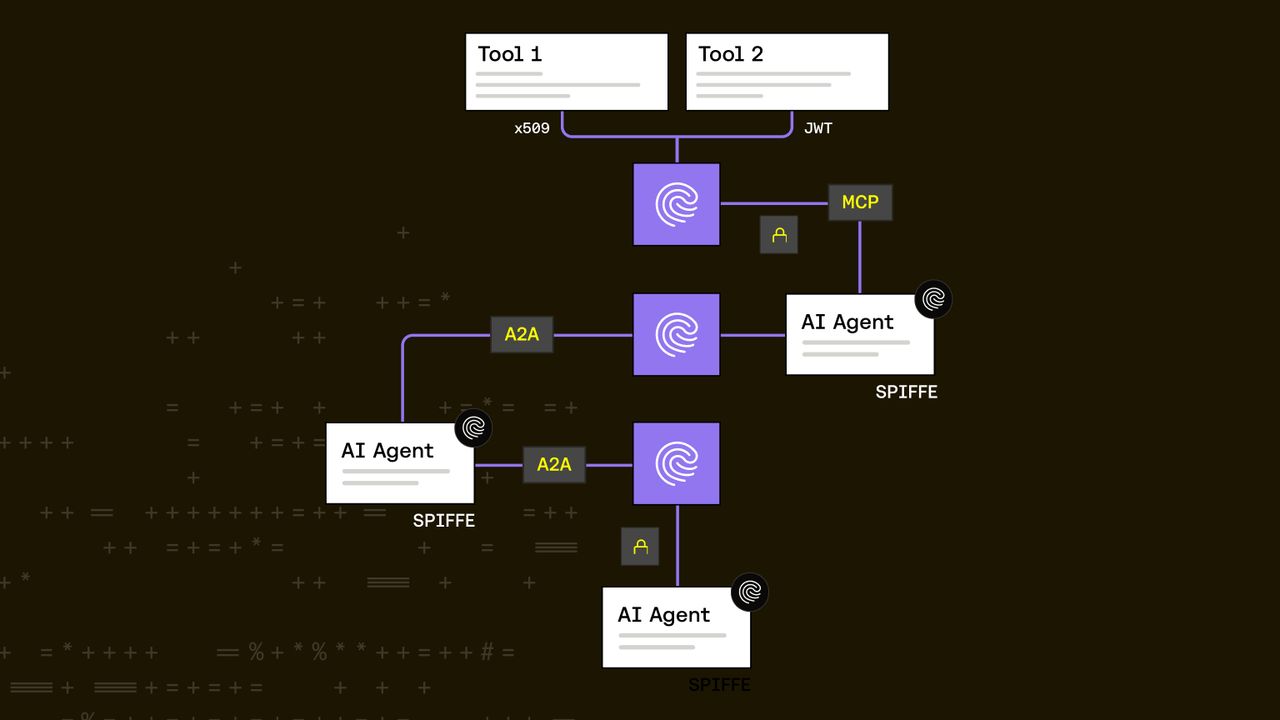
- Ephemeral Identity on Demand: When an agent reaches out to a third-party service, the Riptides kernel module automatically provisions a short-lived X.509 certificate or JWT token that complies with the SPIFFE standard.
- TLS by Default: All outbound communication is automatically upgraded to TLS using these credentials, ensuring encryption without developer effort.
- Agent-to-Agent mTLS: When agents use the A2A protocol to talk to each other, Riptides ensures both ends mutually authenticate via SPIFFE-compliant identities.
- No Credential Leakage: Credentials never touch disk, memory, or user space. They exist only in the kernel and only for as long as they’re needed.
This makes Riptides a powerful fit for the dynamic, distributed nature of AI agent ecosystems—especially when security must be seamless and automatic.
Developers Shouldn’t Have to Be Security Experts
Let’s face it: the average AI agent developer isn’t a security engineer. They want to build functionality, not manage identity lifecycles, TLS handshakes, or certificate rotation policies. When left to their own devices, we see dangerous patterns:
- Credentials hardcoded into agent code.
- API keys bundled into the same container as the agent.
- Static tokens stored in Git repos, config files, or mounted volumes.
These practices are not only unsafe—they scale poorly and introduce massive risk in enterprise deployments.
Riptides eliminates these anti-patterns by removing credentials from the developer’s hands entirely:
- Credentials are generated on the fly, only when needed.
- They are injected by the kernel module, not managed by the developer.
- They are ephemeral, scoped, and automatically expire.
This aligns with the core principles of secure NHI:
- No long-lived secrets
- No human-in-the-loop
- No credentials outside the kernel
As a result, developers can focus on what they do best—building intelligent, composable agents—while Riptides ensures they do so securely, by default.
Conclusion: Riptides Is the Future of Secure Non-Human Identity
In the emerging world of autonomous agents, secure identity is not a luxury—it’s a requirement. AI systems need to communicate safely, prove their identity, and comply with enterprise-grade access controls. SPIFFE provides the right standard for this, but it’s Riptides that brings it to life.
With:
- Automatic, ephemeral credential issuance
- Kernel-level enforcement and TLS upgrades
- Zero developer overhead
- Full compliance with SPIFFE
- Seamless support for MCP, A2A, and third-party integrations
Riptides is not just a solution—it’s a paradigm shift in how we think about identity for AI agents.
If you’re building AI-native systems and want security without friction, it’s time to make Riptides your foundation for NHI.
If you enjoyed this post, follow us on LinkedIn and X for more updates. If you'd like to see Riptides in action, get in touch with us for a demo.